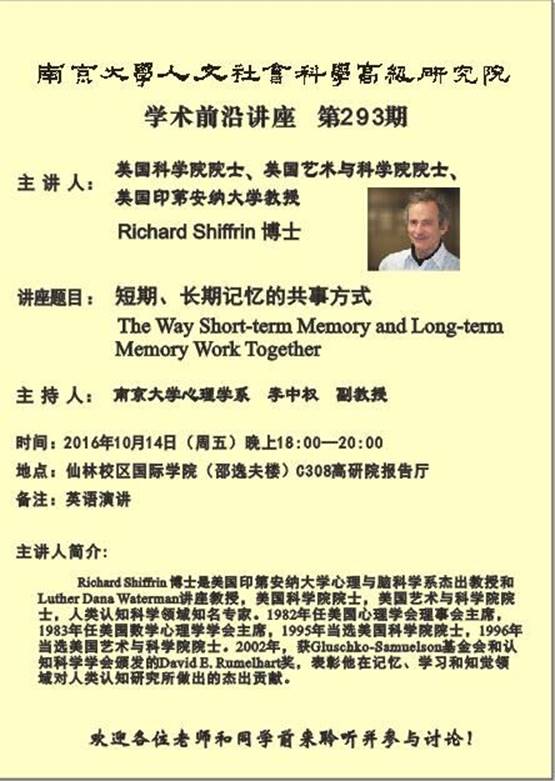
短期、长期记忆的共事方式
The Way Short-term Memory and Long-term Memory Work Together
讲座人:
Richard Shiffrin 博士
美国印第安纳大学教授
美国科学院院士
美国艺术与科学院院士
Richard Shiffrin博士是美国印第安纳大学心理与脑科学系杰出教授和Luther Dana Waterman讲座教授,美国科学院院士,美国艺术与科学院院士,人类认知科学领域知名专家。1982年任美国心理学会理事会主席,1983年任美国数学心理学学会主席,1995年当选美国科学院院士,1996年当选美国艺术与科学院院士。2002年,获Gluschko-Samuelson基金会和认知科学学会颁发的David E. Rumelhart奖,表彰他在记忆、学习和知觉领域对人类认知研究所做出的杰出贡献。
讲座摘要:
Atkinson and Shiffrin (1968) discussed short- and long-term memory, and control processes (often termed ‘working memory’) that governed the way they worked together to govern learning and memory. Shiffrin and colleagues further described the way that long-term memory took over from short-term memory (attentive processes) and produced behavior automatically (Shiffrin and Schneider, 1977) and the co-evolution of knowledge and event memory (Nelson and Shiffrin (2013). Continuing these themes, my colleague Rob Nosofsky and our student Rui Cao have examined the way that the processes that are used to access short-term memory are handed off to a different set of processes in long-term memory when the short-term memory set can be learned. In STM scanning a short list of items is presented in sequence and fairly rapidly, followed by a test item that either is or is not on that list. Size of list has a large effect when the same items are used over and over and change roles (targets or foils) from trial to trial (VM as Shiffrin and Schneider termed it). When the roles do not change from list to list (CM) the target set is learned, long-term memory is used to respond, and the size of list matters little. The transition from short-term search to long term responding and the interactions of these processes are the subject of this talk.
时间:10月14日(周五)晚上6:00-8:00,
地点:南京大学仙林校区国际学院(邵逸夫楼)C308高研院报告厅